Amazon Dimension and Size Diagrams: Drawing Scale Honestly
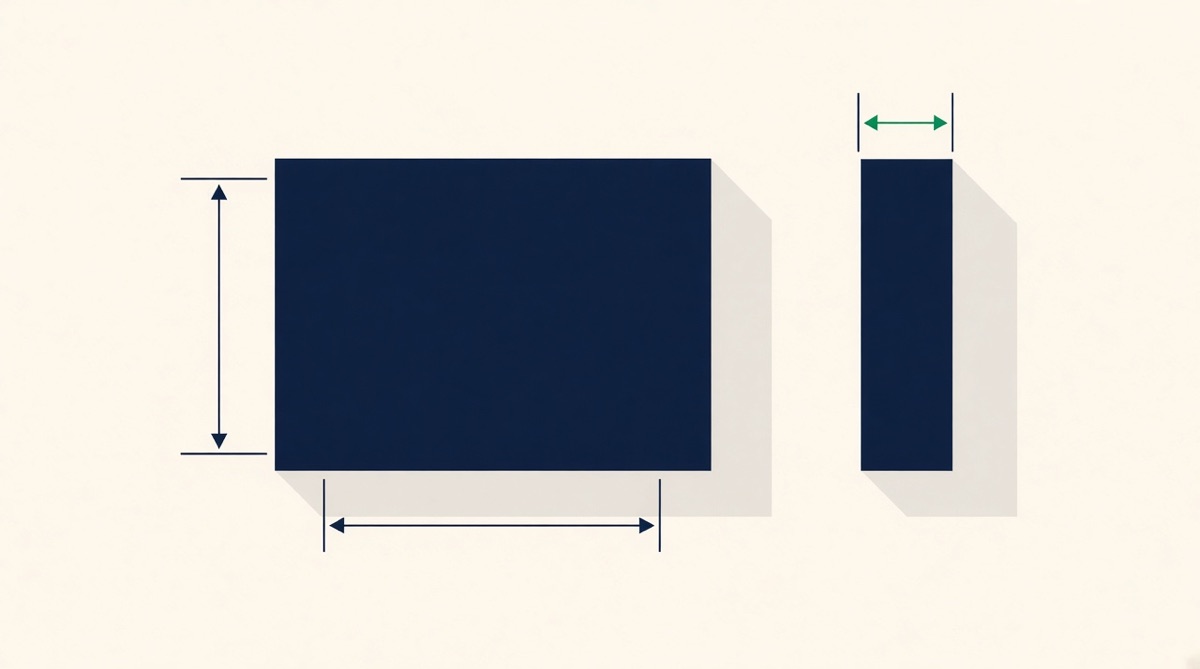
Show two to four measurements, chosen by what constrains the buyer rather than what the factory knows. Pair units in one text object and remember the legal order: Directive 80/181/EEC makes metric mandatory and predominant in the EU, with imperial allowed only as a supplementary indication; on amazon.com inches lead. Use a reference object with a published size — a bank card is 85.60 × 53.98 mm worldwide — never a hand or a phone. And shoot straight on with a long lens, because perspective, not intent, is what makes most dimension images lie.
A dimensions image is the cheapest return-prevention asset you own, and most of them are quietly dishonest. Not through fraud, through optics: a wide lens, a low camera, a coin placed half a metre behind the product, a frame filled to 85% like every other thumbnail in the carousel. This page is about drawing scale you could defend. It covers what to measure, how to pair metric and imperial legally, which reference objects have published dimensions, and the six traps that make a product look bigger than it is.
Check whether size is actually your problem
Before you design anything, get the evidence. In Seller Central, Reports > Fulfilment > Customer Concessions > FBA Customer Returns gives you the reason code the buyer picked. The codes that indict your dimensions image are NOT_AS_DESCRIBED, ORDERED_WRONG_ITEM and NOT_COMPATIBLE. Read the free-text comments alongside them; "smaller than I thought" and "wouldn't fit the shelf" are different failures with different fixes.
The industry context, honestly stated: the National Retail Federation's 2025 Retail Returns Landscape put the overall US return rate at 15.8% and roughly $849.9 billion, with about 19.3% of online sales returned, down from 16.9% and about $890 billion in 2024. On how much of that is size and fit, sources disagree sharply. Compilations of NRF and Appriss data put sizing, fit and colour together at around 45% of retail returns; other 2026 surveys report 60% of shoppers naming wrong size or fit as their top reason. Apparel-specific figures cluster near 50%. Treat any single number with suspicion and use your own report instead.
Measure what constrains the buyer, not what the factory knows
Buyers decide with two to four numbers. The right ones are whichever your customer's space, body or device limits.
| What constrains the buyer | Lead with | Second number | Usually wrong to show |
|---|---|---|---|
| A gap in a room | Width × depth × height | Clearance needed to open or slide | Net weight |
| A shelf or cabinet | Height, then footprint | Height with the lid open | Packaged dimensions |
| A container's contents | Usable interior capacity | Interior dimensions | Nominal or brimful capacity |
| Another device | The exact model fit | Cable or connector length | Generic "universal" |
| A body | Flat measurements per size | Height of the model shown | Vanity size labels alone |
Two distinctions cause most disputes. Interior versus exterior: a 20 L cooler is 20 L inside and considerably larger outside, and the buyer measuring their car boot needs the outside number. Usable versus brimful: state which one you are quoting, in the image, in three words.
Units: the pairing rule is a legal rule in Europe
Showing both systems is not just courtesy. In the EU, Council Directive 80/181/EEC makes SI units mandatory for economic, public-health, public-safety and administrative purposes. Supplementary indications in other units are allowed, but they may not be used on their own and the SI unit has to predominate. On amazon.de, .fr, .es and .it that means centimetres and litres lead, with inches and quarts secondary and visibly subordinate, never alone. The UK retains a derogation covering miles, yards, feet and inches for road signs, distance and speed measurement, which is not a licence to sell in inches alone.
On amazon.com the practical convention runs the other way: inches lead, centimetres follow. So one design serving both sides of the Atlantic needs the unit pair swapped in order, not merely translated. Keep the pair in a single text object — "30.5 cm / 12 in" — so the swap is one edit rather than a redraw.
Round in the direction that costs you the sale. If the product is 30.4 cm and the shopper's shelf is tight, write 30.5, not 30. If capacity is 1.94 L, write 1.9, not 2. A shopper who is pleasantly surprised does not file a return.
Reference objects with published dimensions
A familiar object communicates scale faster than any number, but only if the object has a fixed, known size. These do:
- A bank card. ISO/IEC 7810 ID-1 is 85.60 × 53.98 mm and 0.76 mm thick, identical worldwide. The best single reference for small and flat products.
- A 2-euro coin. 25.75 mm across, 2.20 mm thick, standard across the eurozone. Good for very small parts on EU marketplaces.
- A sheet of paper. A4 is 210 × 297 mm across Europe; US Letter is 215.9 × 279.4 mm. Swap the sheet per marketplace, since they are not the same size.
These do not: a hand (adult hand length varies by roughly a third across the population), a smartphone (models differ by centimetres and the shopper compares against their own), a coffee mug, a pen, a "standard" shelf. If your reference is variable, the image is not evidence, it is decoration. Print the reference object's dimension in the image alongside the product's; it converts a suggestion into a measurement.
One hard constraint: reference objects are props, and props are banned on the main image, which must show only the product on pure white with the product filling about 85% of the frame. Scale references live on secondary images only.
Six ways a dimensions image lies without meaning to
- Short focal length. A wide lens close to the product exaggerates whatever is nearest the camera. Shoot at an 85 mm equivalent or longer, or draw a flat elevation.
- Low camera angle. Shooting up at an object makes it loom. Camera at the mid-height of the product, dead straight on.
- Parallax on the reference. A coin placed behind the product is smaller in frame and inflates the product. Reference object in exactly the same plane, touching or nearly touching.
- Three-quarter angles. Perspective compresses depth precisely where precision is the point. Straight-on front view, plus a side view when depth decides the purchase.
- The frame-fill habit. Every carousel image is filled to roughly the same degree, so relative scale is destroyed by default. A shopper cannot infer size from how big the product looks; you must state it.
- The number that contradicts the spec table. When the image and the product details disagree, the buyer trusts neither. Reconcile the image, the bullets, the details table and the box before uploading.
The arrow conventions matter less than the geometry, but keep them clean: double-headed arrows just outside the silhouette, one per measurement, none crossing, one accent colour, and human labels ("height", not "dim. A"). Amazon requires at least 1,000 px on the longest side for zoom and recommends 1,600 px or more; shoppers zoom into these numbers specifically, so 2,000 px is the sensible working size.
Where Graflio helps
- Pulls dimensions already on the listing so the image and the details table agree
- Reads reviews and flags size complaints as a source of the brief
- Callouts anchored to coordinates on the real photo, so an arrow keeps pointing at the actual edge after an edit
- Unit pairs re-typeset per marketplace with the layout intact
Where it does not
- It cannot measure your product; wrong source numbers produce a confident wrong image
- A badly shot three-quarter photo stays badly shot
- It does not know whether you quoted usable or brimful capacity
- A technical illustrator's orthographic drawing beats any photo-based diagram for complex geometry
What to do first
No dimensions image at all: build one, put it at slot three or four, and lead with the single measurement your returns mention most. One that exists but underperforms: check the geometry before the design, because a three-quarter photo with a hand in it cannot be fixed by better typography. Selling across the EU and the US: split the file, swap the unit order, swap the paper reference, keep everything else. Returns still say "smaller than expected" after all of it: the problem is probably the main image, where the frame-fill rule has taught the shopper nothing about scale, and the fix is a second lifestyle image showing the product in a real setting.
Common questions
Should metric or imperial come first?
On EU marketplaces, metric must come first and must predominate. Council Directive 80/181/EEC makes SI units mandatory and permits other units only as supplementary indications that cannot be used alone. On amazon.com the convention is the reverse: inches lead, centimetres follow. Always show both.
What is the best object to show scale against?
Something with a published, fixed dimension. A bank card is 85.60 × 53.98 mm under ISO/IEC 7810 worldwide; a 2-euro coin is 25.75 mm across; A4 is 210 × 297 mm and US Letter is 215.9 × 279.4 mm. Avoid hands and phones, which vary enough to mislead. Print the reference object's dimension in the image too.
Can I put dimensions on the main image?
No. The main image must show only the product on a pure white background at RGB 255,255,255, with the product filling about 85% of the frame and no text, arrows, diagrams or props. Dimensions belong on a secondary image, ideally in the first half of the carousel.
How do I know whether size is causing my returns?
Use the FBA Customer Returns report in Seller Central, under Reports, Fulfilment, Customer Concessions. Look for the NOT_AS_DESCRIBED, ORDERED_WRONG_ITEM and NOT_COMPATIBLE reason codes and read the buyer comments beside them. Published industry figures for the share of returns caused by size and fit range from about 45% to about 60% depending on the survey, so your own data is worth more than any benchmark.
How many measurements should the image show?
Two to four. Lead with whichever the buyer's space, body or device actually constrains, add the one your reviews complain about, and stop. Six or more numbers bury the two that decide the purchase, and at carousel scale they stop being legible anyway.
This page is written by Graflio, so read our own column with appropriate suspicion. Competitor facts are the vendors’ published information as of August 2026 and change often — check before you buy.
Paste one ASIN. Get the whole set.
Graflio reads the live listing and its reviews, studies the best sellers around it, then renders a full set of on-brand infographics — every image still editable in a layer studio. €10 of credits free, no card.
Try Graflio free →