Amazon Listing Images for Kitchen and Cookware Brands
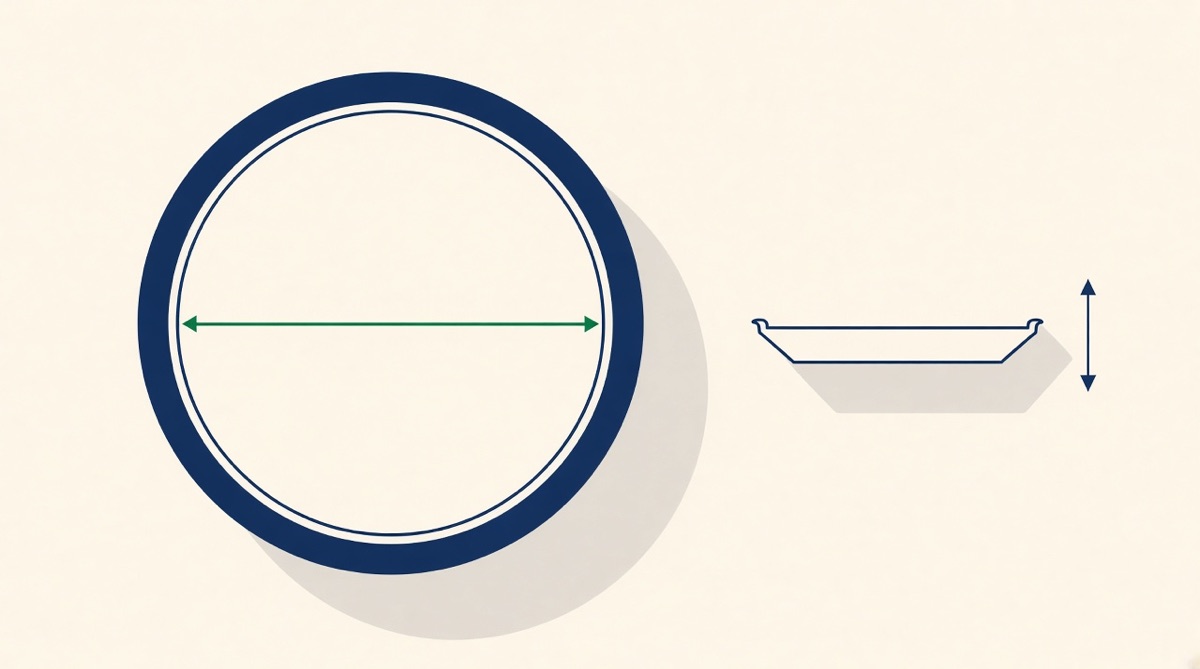
In kitchen and cookware the hardest question is the one a photograph cannot answer: how big is it, and will it fit. The category leaders solve it early and literally — Owala gives a whole slot to a size table in inches and centimetres with "1.4 disposable water bottles" as a reference object, and an 8-inch air fryer liner listing draws three measured dimensions plus a 5–8 qt basket range in slot two. Print numbers, not adjectives: "heat resistant" loses to "−50 °C to 300 °C", and every superlative needs its source in the same frame.
Kitchen and cookware listings lose sales to one recurring failure: the shopper cannot tell how big the thing is, or whether it survives their dishwasher, oven or air fryer. A kitchen photograph gives no reliable sense of scale, because a countertop offers no fixed reference. The category's best sellers fix that with measured diagrams, named comparison objects and printed temperatures — in the second or third slot, before anyone reaches the bullets.
The scale problem, and how the leaders actually fix it
Photograph a 24 oz bottle on a worktop and it could be 16 oz or 40 oz. Owala's FreeSip listing gives a whole slot to a frame headed "Size Comparison": the 24 oz and 32 oz bottles side by side, and beneath them a table of size, height, width and comparison. Height and width appear twice, in inches and centimetres. The last column is the interesting one — "1.4 disposable water bottles", "1.8 disposable water bottles" — converting a measurement into an object the buyer already owns. Most sellers skip that translation step.
The 125-piece air fryer liner listing does the same for fit. Its second image draws three dimensions on a single liner — 9.2 in across the top, 8 in across the base, 1.8 in of wall — beside a badge reading "8 Inch, 5~8 Qt Basket" and five appliance thumbnails: air fryer, oven, microwave, steamer, toaster oven. Three numbers, one capacity range, five machines. "Will it fit mine?" is answered before it is asked, and that is the question that produces the return.
| What the buyer needs | Weak version | What the bestsellers do |
|---|---|---|
| How big is it | Styled photo on a counter | Dimensions in in and cm plus a familiar reference object |
| Will it fit | "Universal fit" | Three measured dimensions plus a capacity range and named appliances |
| Can I heat it | "Heat resistant" | The temperature, in °C and °F, printed in the frame |
| What arrives | Hero shot of one unit | Counted flat-lay, including consumables and spares |
| Why this one | "Premium quality" | A comparison with the footnote that sources it |
Footprint is a separate argument from size
Small appliances compete for counter space, and the bella Fits-Anywhere slim toaster argues that directly. Slot two puts a conventional two-slice toaster beside the slim one under "Same 2-slice capacity, smaller footprint", with a badge reading "Save up to 50% more space" and a footnote in the same frame: "Compared to prior similar bella items". The comparison sells; the footnote is what makes it defensible.
Another slot carries a "#1 Toaster Brand" badge with, in small type immediately beside it, "Claim based on Circana U.S. retail sales, Jul '24 – Jul '25". If you put a superlative in an image, put its source in the same image. bella also runs a two-column "Our toaster / Their toaster" grid of ticks and crosses against a generic unbranded black toaster — the safe form of a comparison image. Compare against your own range or an unnamed generic; do not build an image that disparages a named competitor.
Materials, heat and dishwashers: print the number
The air fryer liner listing runs a four-icon strip: Climate Friendly, Heat Resistant, Effortless Cleaning, Oil & Water Proof. "Heat resistant" is the weak one, because a shopper about to run a fryer at 200 °C needs a figure, not an adjective. Compare the Alpha Grillers instant-read thermometer, which prints its full range on the product body and again in the gallery: −50 °C to 300 °C / −58 °F to 572 °F. Dual units, in the frame, no interpretation required.
Apply the same discipline to every material claim. "Dishwasher safe" should say whether that means top rack only. "Oven safe" should carry the maximum temperature and whether it covers the lid and handle. "PFOA free" says less than shoppers think: PFOA has been out of US production since roughly 2015, so on a new pan it is close to a statement that the product is legal, and it does not mean the coating is free of other PFAS. If the coating is your differentiator, name it.
In the EU, food-contact status is regulated rather than decorative. Regulation (EC) No 1935/2004 requires articles not yet in contact with food to carry the words "for food contact", a specific indication of use, or the glass-and-fork symbol, exempting articles whose purpose is obvious such as cutlery. The symbol is a compliance mark, so reproducing it in a gallery image is a claim you must be able to evidence.
Sets, counts and the "I thought this came with lids" review
Anything sold as a set needs one frame that counts. Lay every piece out, label each one and state the total in the same image, including the parts people forget to expect: lids, seals, spare gaskets, batteries. Alpha Grillers gives that its own line — "Battery pre-installed. Ready to go + spare backup battery included." Variation families need the same care in reverse: if your parent listing has six sizes, the size frame belongs on every child, not only the one you launched first.
What not to copy from the top of the category
Two of the largest kitchen listings are almost information-free. The KitchenAid can opener spends its gallery on staged countertop scenes with copy like "craft creations for family meals and gatherings"; Stanley's IceFlow tumbler gives a slot to an editorial photograph of a man leaning on a vintage Cadillac, carrying no product information at all. Both sell enormously and neither is a template. They work because the brand is already the reason for the purchase. An unknown brand borrowing that style is asking the shopper to take a measurement on faith.
Where Graflio fits
Useful here
- Callouts are pixel-anchored, so a dimension line stays attached to the rim it measures when you move it
- Numbers stay text layers, so one frame can be re-cut for a second size without redrawing it
- Multilingual output handles the unit swap for amazon.de and .fr, where centimetres and °C lead
Not useful here
- It cannot measure your product. Every dimension comes from you, and an honest diagram needs a tape measure first
- There is no batch mode in the image UI — a 40-SKU cookware range is still built listing by listing
- Generated images are 1,024 px, above the 1,000 px zoom floor but below the 1,600 px recommendation; a dense dimension diagram wants the 2,160 px Studio export
The order to build a kitchen set
Measure first, then write the frames. Slot two is the dimension diagram, both unit systems, with a familiar object for scale. Slot three is fit or footprint, compatibility range spelled out. Slot four is heat, cleaning and material, with real numbers. Slot five is what arrives, counted. Slot six is the comparison, with its footnote in the frame. Lifestyle gets what is left — and if you are a new brand, that should be less than you want.
Common questions
Where should the dimension diagram go in a kitchen listing?
Second or third, ahead of lifestyle. Scale is the first thing a shopper cannot resolve from the main image. Owala gives the size comparison a whole slot; the 8-inch air fryer liner listing puts its measured diagram in slot two.
Should I put dimensions in inches or centimetres?
Both, in the same frame, on the US listing too. Owala prints 10.6 in / 27.1 cm side by side. On amazon.de, .fr and .es lead with centimetres and °C, and rebuild the frame rather than pasting a converted number over an inch-based drawing.
Can I compare my product to a competitor in a listing image?
Compare against your own range or an unnamed generic, as bella does with its "Our toaster / Their toaster" grid. Do not disparage a named competitor, and put the source of any superlative in the same frame — bella cites Circana US retail sales beside its "#1 Toaster Brand" badge.
How do I make heat and dishwasher claims safely?
Print the number and the qualification. "Heat resistant" tells a buyer nothing; a range like −50 °C to 300 °C does. Say whether dishwasher safe means top rack only, and whether oven safe includes the lid and handle. PFOA has been out of US production since roughly 2015, so "PFOA free" is not evidence that a coating is free of other PFAS.
Do I need the food-contact symbol on my images?
Not on the images, but you need the compliance behind it. Regulation (EC) No 1935/2004 requires articles not yet in contact with food to be marked "for food contact", or with a specific indication of use, or with the glass-and-fork symbol, exempting items whose use is obvious such as cutlery. Reproducing the symbol in a gallery image is a claim you must be able to evidence.
This page is written by Graflio, so read our own column with appropriate suspicion. Competitor facts are the vendors’ published information as of August 2026 and change often — check before you buy.
Paste one ASIN. Get the whole set.
Graflio reads the live listing and its reviews, studies the best sellers around it, then renders a full set of on-brand infographics — every image still editable in a layer studio. €10 of credits free, no card.
Try Graflio free →